Fonseca, Gonçalo L. “The Neo-Keynesians.” The History of Economic Thought, Institute for New Economic Thought, http://www.hetwebsite.net/het/schools/synthesis.htm.
Summary: I spent the last blog post talking about how Keynesian economics was the first will developed economic theory, but has been replaced by Neokeynesian ideas. This article describes the issues with simple Keynesian thought.
The big revelation Keynes had that was not present in the Classical school was that the market is not guaranteed to be efficient. Keynes said that supply will only ever reach demand, and that if demand is too low, supply will shrink, and 100% employment is not guaranteed. Keynes formalized this with something called the Keynesian Cross, which looks like this:
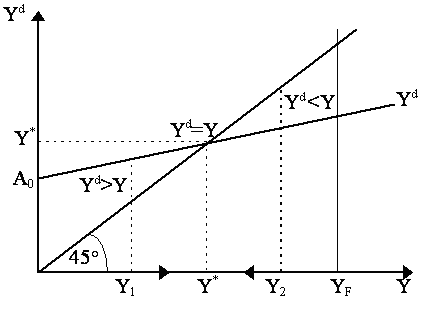
That image is taken from the same History of Economic Thought website I cited, from the article on the IS-LM model. It shows how supply, demand, and employment are related, as described by Keynes. The X axis is employment: Y1 is the lowest possible employment rate, Y* is the realistic or determined unemployment, and YF is the full employment rate. The YD line is demand, and Y is supply/employment. If demand is lower than supply, supply will decrease until they are even. The inverse is also true.
However, Keynesian economists had a problem. Although Keynes writings and this simple graph demonstrated that the employment rate should be lower than full, when the system of differential equations was constructed and all the numbers were plugged in, Y* approached YF, a result predicted by the classical model.
This was a big controversy for a while, until people realized their models were too “slippery”. They were ignoring many factors in the economy, that could delay the efficient movement of running, such as inflation, concerns about job security, some taxes, and other things. This idealized market tended towards YF, but was not accurate.
Once the Keynesian models were updated with all of the new terms and equations, we had the Neokeynesian school, which was much more true to real life.
Analysis: Neokeynesian economics is one of the two big schools of economics I’m going to be comparing, along with Neoclassical. It’s very complicated, mainly based around complex differential equations and fine tuning parameters to more closely match what we see in real life, but it’s one of the most accurate models we have. The website I cited in this post seems to be very good, with a vast variety of terms and people defined, although it’s highly technical and difficult to read.

 Anthony Dellinger's Research Blog