Keynes, John Maynard. The General Theory of Employment, Interest, and Money. Palgrave Macmillan, 1936.
Summary: This is a 260 page book that would be in an academic journal if it wasn’t so long. So, although I’ve read some of the middle chapters, I have no intention on reading all of this, especially because it was published in 1936 and is not really considered to be true any more. However, because it is no longer considered to be a modern theory by economists, the only articles about the Keynesian school of thought are brief slides in a professor’s lecture introducing the Neokeynesian school, or long form articles using Keynesian thought as a straw man to attack big government with.
For examples, https://www.econlib.org/library/Enc/KeynesianEconomics.html is an article talking about Keynesian ideas. You will notice it’s published by “The Library of Economics and Liberty”, a foundation dedicated to spreading libertarian ideals. And since Libertarianism is the direct opponent of Keynesian and Neokeynesian thought, the article on Keynesian Economics is far from objective. This is a direct quote: “Keynesians also feel certain that periods of recession or depression are economic maladies, not, as in real business cycle theory, efficient market responses to unattractive opportunities.” So this article both implies that Keynesian economists are still a thing that exists, and that Keynes did not make a “real business cycle theory”.
So I’m just going to cite Keynes directly, with the caveat that most of his ideas are out of date. But I think a foundation of Keynesian economics is necessary to compare Neokeynesian and Neoclassical economics. I won’t bother citing Classical economics since it’s nothing more complicated than “the more free the market the more efficient it will become”. There’s no math or anything.
But Keynes did have math, and a lot of it. He formalized theories of supply and demand. He created mathematical objects describing consumption, investment, government spending, total demand, total output, stored inventory, employment, savings, taxes, and other financial instruments. And he then constructed a system of equations describing the relationships between instruments. Here’s a sample:
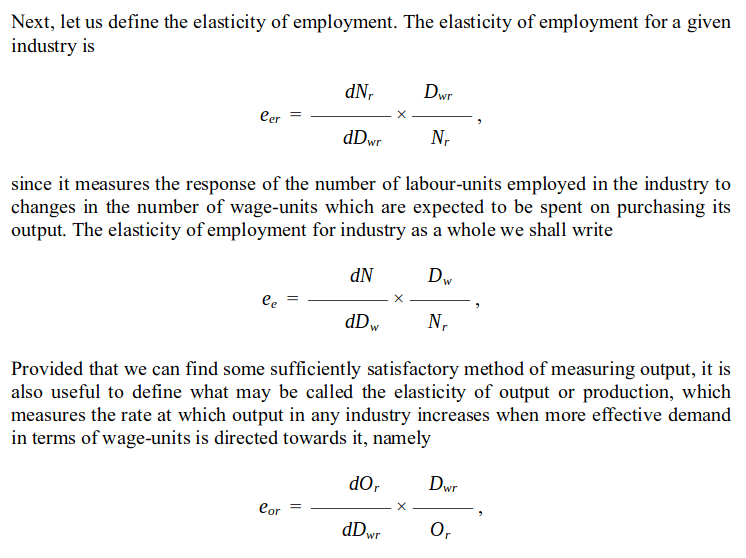
Analysis: Even though Keynes’ ideas have been replaced with more accurate models, he was influential in founding modern economics. He was one of the first people to create mathematical models of different economic theories, and his ideas helped lead to the big government policies of the 40s and 50s.
However, I am not writing a history paper. I am not including information on Keynesian thought because it was historically important, and especially not because it’s still relevant today – it isn’t. However, I think it is difficult to discuss Neokeynesian ideas without a firm understanding of what the Keynesian school was, so it will be included in the paper.

 Anthony Dellinger's Research Blog